Search This Blog

Tuesday, July 1, 2025

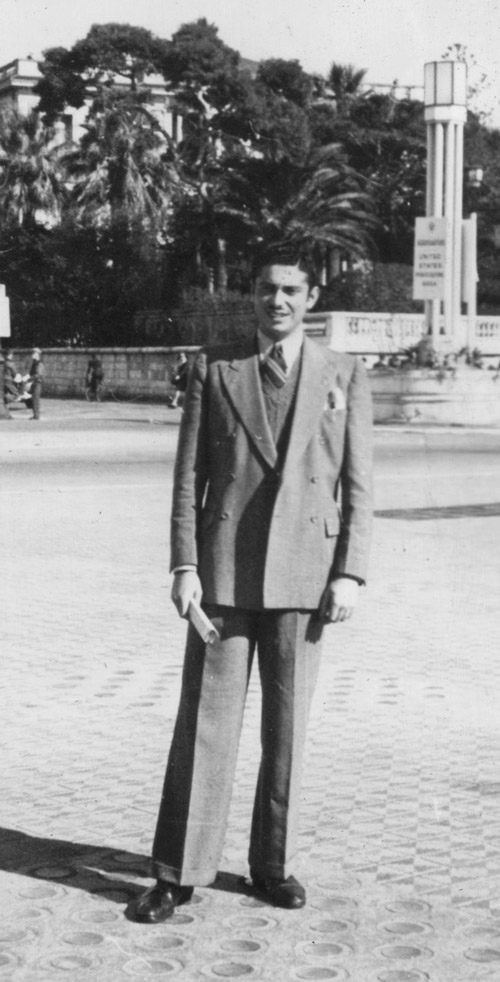
Leon Idas, born July 11, 1925, Fought for the Liberation of Greece at 16

"We are Jewish, and you know what happened to the Jews, I said, they round them up and we come here, we didn't care if it is Communists or Royalists or Democratic, Conservative, we come here to become Partisan, to fight the common enemy — the Nazis." – Leon Idas.

Leon Idas was born July 11, 1925 in Athens, Greece. He grew up in an ethnically diverse neighborhood with his father, a textiles merchant, mother, four brothers, and sister. Leon attended a private school run by the Greek Orthodox Church. The Christian theology Leon learned proved useful as a means to keep his Jewish identity hidden during the war.

Shortly after the beginning of the German occupation of Greece in 1941, sixteen year-old Leon joined a group of partisans fighting for the liberation of Greece under a socialist banner. At that time, there were three groups of partisans in Greece: socialist, democratic, and loyalist. Leon fought and served as communications specialist with the partisans for more than three years, winding wires through the trees in various villages to establish telephone communication.


Leon Idas training to use a machine gun.

The partisans lived in bases in the mountains of Greece where they organized armed resistance against the German army. Aided by nearby villages, British airdrops of supplies and their own resourcefulness, the partisans primarily employed ambush and guerrilla tactics against the German army. The Germans in turn attempted to eliminate the partisans by destroying villages that supported them.


Leon Idas (middle) with two army friends

Leon spent more than three years with the partisans. During that time, Leon suffered through hunger, lice, a lack of adequate clothing, and had virtually no contact with his family, save for a single encounter with one of his brothers who was fighting for another partisan group.

At the end of the war, in December 1945, Leon left the partisans and returned to his family home in Athens. Once there, he was reunited with what was left of his family and learned that his parents and brother Gabriel had died in Auschwitz during this time.


Leon eventually made his way to the United States with no more than 50 cents in his pocket, and settled in Baltimore, Maryland. He married and raised a family of three sons and one daughter, and started his own clothing business, Royal Vintage Clothing. Leon passed away on April 12, 2013, and was laid to rest in the private Jewish Family Cemetery on the island of Samos, Greece, alongside his grandfather Leon Goldstein and Uncle Albert Goldstein.

Visit www.jewishpartisans.org for more about Leon Idas, including seven videos of him reflecting on his time as a partisan. Leon's son, Sam Idas, has created a photo montage of Leon's life. He was gracious enough to share it with JPEF - click here to view the montage video.

Monday, June 30, 2025

Shalom Yoran - The Defiant [Born June 29, 1925]

Shalom Yoran was born Selim Sznycer in 1925 in Warsaw, Poland. When Shalom was 15 years old, his family fled east, leaving the Nazi-occupied area of Poland for the Soviet side. However, a year later the Germans invaded the Soviet Union, and the Yoran family found their new home, the village of Kurzeniec, occupied by the Nazis.

Two years later, in 1942, the Nazis established a Russian POW camp in Kurzeniec, where the prisoners were treated brutally. Shalom first learned about the partisans through stories he was told by escaped Soviet POWs. The day before Yom Kippur 1942, the Kurzeniec ghetto was ordered to be liquidated.

Shalom was given an early warning, but his family was not as lucky. Shalom and his brother Musio managed to hide themselves in a barn in the nick of time, and were forced to listen as the entire remaining population of the ghetto, totaling 1,052 people, were murdered. The brothers later found out their parents were among them. The farmer whose barn they hid in turned out to be friendly, and the brothers safely made it to the woods – the Naroch puscha – where they found many other survivors in hiding. Shalom reasoned it was only a matter of time before the Germans conducted an organized raid on the forest, so the brothers decided to leave the area. After the brothers recruited three younger refugees to follow them, the boys spent the frigid winter of 1942 in the forest near the river Sang, where they built a zemlyanka for shelter and lived mostly off a large store of food they took from local farmers.

Detailed map of Shalom's journey through northeastern Poland

At first, they resorted to stealing and begging, but Shalom eventually had an idea: he fashioned the tops of his boots into a holster, and whittled a wooden handle to look like the one on a Soviet Nagan revolver. No longer needing to steal potatoes in the dead of night, Shalom now demanded provisions, brandishing his holstered "weapon." The balance between menace and generosity was of vital importance, and for a long time the peasants did not suspect anything.

However, one night as they ventured into the village one last time to acquire matches, an angry mob chased them down and beat them with sticks. Though he was robbed of all his clothing, Shalom miraculously escaped with his life, and even managed to avoid frostbite as he ran barefoot through the snow. Luckily, all five of the group survived the assault and managed to return to the zemlyanka.

In the spring of 1943, Shalom and the group ventured out of their hiding area. By this time, the tide was turning for the Nazi war effort, and the German army was suffering serious setbacks both in Africa and on the Eastern Front. On the road to Zazierie, the boys encountered fellow survivors of the Kurzeniec ghetto and a group of partisans roaming the village. Since neither he nor his group had weapons, Shalom was denied entry into the group — a common practice among the partisans. Unsure of what to do, Shalom and his brother stayed in the puscha. Though their winter companions went their separate ways, they were soon joined by others, including some escapees from a labor camp in Vileika.

Shalom and his companions spent the rest of the spring trying to join partisan groups roaming the area, but without weapons, they received the same reply every time. Finally, a partisan commander relented and offered them a deal: they would be allowed into the partisans if they returned to Kurzeniec and burned down a factory that made wooden rifle butts. For this mission, they were given a handgun with a single bullet and two hand grenades. Despite the odds, they were successful. However, when they returned to the partisan camp, they were met by a different officer, who took away their weapons and reprimanded them, threatening to shoot them if they didn't leave. The Russian partisans never even thought they could succeed, and had no intention of letting Jews into their group. Little did they know that the group's commanding officer – the one who initially gave them the assignment – was himself a Russian Jew.

Shalom's lucky break came when the commander of a "specgruppa" – a small unit created for a specific purpose – came through the area looking for guides. During the Soviet retreat in 1941, the local peasants had picked up many weapons abandoned by soldiers. The group's mission was to find and collect these weapons, along with food. Here, Shalom witnessed first-hand the methods of Soviet-style coercion, which ranged from the polite display of a grenade on the table to beatings and mock executions.

But in the end, the specgruppa found the weapons caches, and for his work, Shalom and Musio were both given working rifles (though Shalom's did not have a butt, and Musio's was sawed-off).

Shalom in British uniformAfter his work with the specgruppa, Shalom heard rumors of the formation of an all-Jewish otriad, organized by one Colonel Markov, who by that time had a brigade of over a thousand partisans under his command. He was in contact with the FPO in Vilna, and their members formed the core of an all-Jewish otriad called Miest - the Russian word for "revenge". Since they brought weapons, Shalom and his companions were readily accepted into the unit. In the wake of the German defeat at Stalingrad, Shalom’s unit ambushed the retreating German troops, cutting communication lines, blowing up bridges, and destroying railroads. The unit was disbanded and merged with another otriad some months later. This would not be the last all-Jewish unit Shalom belonged to during the war – and, unfortunately, not the last to be disbanded by the Soviet high command.

When Belarus was liberated by the Soviets in 1944, Shalom and the rest of his comrades were drafted into the Russian regular forces. Fighting in the Red Army, he was appalled by the brutality and political persecution he experienced. Eventually he deserted and made his way to Italy, where he worked for the British Army through the end of the war.

In 1946, Shalom traveled to Palestine with the aid of a fake British Military passport, and joined the newly formed Israeli Army. Though he left Israel to attend an American university, he returned to become an officer in the renowned Israeli Air Force. Shalom became a leader in the Israeli aerospace industry.

Shalom moved to the US in 1979 where he lived with his wife, artist Varda Yoran. Shalom passed away on September 9, 2013 leaving a tremendous legacy.

In 2003, he published his memoir, The Defiant: A True Story of Escape, Survival & Resistance. The book, written shortly after the Shoah but rediscovered many years later, is dedicated to his parents. Click here to listen to Larry King reading excerpts from the book.

From left to right: Shalom, Steffi, Markh, and Musio. Steffi was the widow of Markh's close friend in Vilna. Budapest, 1945.

Thursday, May 8, 2025

More than 15,000 People Today Owe Their Lives to Tuvia Bielski (z''l), Born May 8, 1906

Over seventy years ago on a rainy night, Rae Kushner, her sister Lisa, along with Sonya and Aaron Oshman, escaped through a narrow tunnel from the Novogrudok ghetto together with 250 other Jews. They hid in an area nearby to elude the pursuing Germans and their collaborators. Many in the group were shot and killed. Rae, Lisa, Sonya, Aaron and others were rescued by the Bielski partisans, who had heard of the group’s escape and sent in scouts to take the survivors from Novogrudok to safety.

The group, founded by Tuvia Bielski and his brothers Asael and Zus – along with help from youngest brother Aron – provided a haven for all Jews fleeing the Nazis and their collaborators. For three years, the Bielski partisans survived in the forests of Belarus, engaging in armed combat and disrupting the Nazi war machine with acts of sabotage. Their primary mission, however, was always the preservation of Jewish lives. Tuvia proclaimed, “I would rather save the life of one old Jewish woman than kill ten Nazis.” By the end of the war, the Bielski partisans managed to save over 1,200 Jews.

Tuvia was one of 12 children, born to a miller father on May 8, 1906 in the rural town of Stankiewicze. They were the only Jews in a small community, and quickly learned how to look after themselves. When the Germans invaded in June 1941, the brothers sought refuge in the woods where they had spent time as children. Asael and Zus, who were hiding together, set about finding safe homes for a dozen or so of their surviving relatives. Tuvia, who was staying further to the north, moved relatives in with friendly non-Jews. But by the spring of 1942, the three decided it was time to relocate all the relatives into a single location in the woods.

The brothers moved quickly to build a fighting force from the escapees. These escapees joined forces with the growing group of Soviet partisans who were engaging in guerrilla attacks against the occupiers. In October 1942, a squad of Bielski and Soviet fighters raided a German convoy loaded with supplies, killing at least one German soldier. “It was satisfying in a larger sense,” Tuvia wrote of the first attack on Nazis in his 1955 Yiddish language memoir, “A real spiritual high point, that the world should know that there were still Jews alive, and especially Jewish partisans.”

The group continued to grow until the end of the war. Committed to protecting all Jews – regardless of age, gender, socio-economic status, or level of religious observance – the Bielski Otriad provided shelter for Jews like Rae, Lisa, Aaron and Sonya. They worked endlessly to free hundreds of Jews from other ghettos. Among them were Leah Bedzowski Johnson, her sister Sonia, brothers Charles and Benjamin, and their mother Chasia, who escaped from the Lida Ghetto with Tuvia’s help. Sonia Bedzowksi was later captured en route to the Lida ghetto to secure medicine for the partisans and killed in Majdanek. The rest of the Bedzowski family stayed with the Bielski Otriad until the end of the war. Now living in Florida, Leah expresses her lifelong gratitude, and praises Tuvia’s leadership and humanity: “Tuvia Bielski was our commander. He was always around us and he wanted only to save Jewish lives to make sure that our people continued and multiplied. I would not be alive today if it was not for Tuvia and neither would my children, grandchildren and great grandchildren.”

Bielski partisans guarding an airstrip. Leah's husband, Velvel "Wolf" Johnson, is in the bottom center with his machine gun.
While imprisoned in the Lida Ghetto, Michael Stoll had heard tale of the Bielski partisans and vowed to escape and join the group. That chance came when he and 11 others jumped from a train bound for the Majdanek concentration camp. Finding themselves in the middle of “no man’s land,” they were eventually able to connect with the Bielski Otriad. Michael says, “If it had not been for Tuvia, we would not have survived. He was a good man. A legend.”

Operating in the Naliboki forest, Tuvia set up a functioning partisan community that included a hospital, classrooms for children, a soap factory, tailors, butchers, and even a group of musicians. Everyone in the Bielski Otriad worked to support one another – even the youngest children like Ann Monka contributed by keeping people’s spirits up with singing and entertainment. Ann recalls that Tuvia had special pride for the children of the Bielski Otriad, and took great strides to protect them and ensure their survival. “At one time there was a rumor that he was going to send some of the children to Moscow since we did not know when the war was going to end. He wanted to make sure that the children were safe. The children were the future of the Jewish people. We would not be here if it were not for him. Without him we had no chance for survival. Thousands are alive because of Tuvia.”

Indeed, because of Tuvia’s strong and effective leadership and his determination to save as many Jewish lives as possible, there are more than 15,000 people today who owe their lives to him. They are the children, grandchildren and great grandchildren of Rae Kushner (z''l), Lisa Riebel(z''l), Leah Johnson, Charles Bedzow, Benny Bedzow (z''l), Chasia Bedzowski (z''l), and Sonya and Aaron Oshman (z''l), and 1,200 other survivors of the Bielski Otriad.

Tuvia and Lilka together after the liberation.
While in the forest, Tuvia met and married Lilka. Together they had three children: Michael (Mickey), Robert and Ruth; and nine grandchildren: Jordan, Taylor, Ariel, Tori, Sarah, Brenden, Sharon, Talia, and Vanessa. After the war, Tuvia and his family moved to Israel, and then later to the United States. For more than 30 years, he and his brother Zus operated a trucking company in New York City. Tuvia passed away on June 12, 1987 at the age of 81.

Inspired by Tuvia’s remarkable courage and compassion, and the legacy of the Bielski Otriad, in 2008 Paramount Pictures portrayed his story in the major motion picture “Defiance”, starring Daniel Craig as Tuvia (see an image of Daniel Craig as Tuvia on a fake cabbie license for a scene that ended up getting cut from the film). In cooperation with Paramount and film director Edward Zwick, JPEF developed a unique curriculum for educators, which incorporates scenes from the film to engage students in critical thinking about History, Leadership, Ethics, and Jewish Values.

Leaders of the Bielski otriad posing in front of an Israel-bound ambulance they helped fund, circa 1960s. From the right: Tuvia & Lilka, Zus & his wife Sonia, Lea and Pesach Friedberg.
Visit www.jewishpartisans.org/defiance for more about the Bielksi partisans and the film 'Defiance', including a 5-page Tuvia Bielski study guide/biography. Educators can take a free online class on how to teach about the Bielskis and use the guides, films, and lesson plans with our E-Learning platform.

Watch a short film on the Bielskis, narrated by Ed Asner, here:
In 2013, JPEF honored Tuvia, his brothers Asael, Zus and Aron, and all Bielski partisans, at a dinner in New York City. Eighteen surviving Bielski partisans attended the gala, where "The Legacy of the Bielski Brothers", narrated by Liev Schreiber, and featuring partisans and their children, was shown.

Wednesday, May 7, 2025

Jewish Partisans Joe (z'') and Rose Holm

This mini-biography tells the story of two Jewish partisans in Poland who fought in Chiel Grynspan's unit and later married one another.

Jewish partisans Rose Duman and Joe Holm were born in neighboring villages near Zaliscze, Poland. In 1941, Germans killed Joe's mother and five brothers, as well as 20 other members of his family. At 19, he entered the forest, where he knew other Jews were gathering.

Joe Holm met Chiel Grynspan and other partisans in the forest, where he proved himself skilled with a gun, and adept at demolition. Holm had two roles: his extensive knowledge of the forest and local villages made Holm an invaluable guide for his group. Holm also traveled in and out of the forest, finding food and medical supplies necessary for the unit's survival.

Near Zaliscze, Rose’s family owned a prosperous farm, where Joe would often stay overnight on Shabbat. When partisan groups began allowing a few women to join, Joe appeared on Rose's doorstep. He said, “I'm going; you come with me.”

As partisans, Rose and Joe carried out dozens of missions. Once, traveling with a Polish general into the forest, their group was ambushed. Joe and Rose ran through gunfire, and managed to deliver the General safely to the camp. Later, Rose found bullet holes through her sweater, as a testament to their narrow escape. In another narrow escape, Joe Holm and his cousin Jack Pomeranc stood before a firing squad with 80 other partisans, and prepared to be executed. Just before the signal to fire was given, Joe said, “Watch me, and do what I do.” He wrestled a gun from a German soldier and started firing. Joe Holm was shot in the arm, but they and two other prisoners escaped. All the rest were killed.

Rose and Joe stayed with the Grynspan unit for the duration of the war, living in the forest for over three years. Later, Rose and Joe married and left Poland for Germany, eventually emigrating to the United States. In New York, they built a family and a successful business. Joe Holm died in 2009. They were married for 65 years.

“We survived with our bare hands,” Rose recalls. “I just wanted to live, to see the end of Hitler,” she adds. “I was angry. It was important to me to do something, before I died.” On teaching the history and legacy of the Jewish partisans, Rose Holm says, “It is important to teach kids to fight back. To speak up.”

Visit www.jewishpartisans.org for more about Rose and Joe Holm, including four videos of Rose Holm reflecting on her time as a partisan.

Monday, May 5, 2025

Jewish Partisan Leon Bakst (z''l) was born on May 3, 1923

Leon Bakst was one of four siblings born to a wholesale merchant in Ivie, a small Polish town 73 miles west of Minsk. Leon was 15 when the German army invaded eastern Poland in the summer of 1941, occupying Ivie and forcing the town’s Jews into a ghetto.

When the Germans asked Leon’s father what he did for a living, he lied and told the Germans that he was a brush maker. Though he traded in raw materials required for making brushes, he had never actually made a brush in his life. However, he figured that the occupiers would have more use for a tradesman than a merchant. His assessment of the situation was correct – he was spared the initial massacre of influential Jewish men. It would not be the last time his quick wits would save him and his family from annihilation. During the next round-up, as the family was approaching the SS officials in charge of choosing the next massacre victims, Leon’s father put his wife and daughters behind himself and his two sons – he realized the Nazis were more likely to spare able-bodied men than families with lots of women and children. The gamble paid off: seeing only a father and his two teenage sons from their vantage point behind the table, the SS men hurriedly dismissed the family.

The Bakst family.

By this point in the war, the Nazis were not particularly concerned about hiding their true plans for the Jews of Poland. Leon and his brother were among those forced to dig mass graves a mile outside of their town. Leon remembers seeing the soldiers execute one of the crew:

“It was a Rabbi’s son – he had a little bit…one arm. [It] wasn’t as strong as the other; it was kind of a weak arm. So after we got through digging out, before we’re fixing to go back to the ghetto, [they] shot him, right there in front of the grave. And we left.”

Months later, Leon and his older brother, along with 200 other young people, were selected by the local Judenrat council to go to a labor camp in Lida, another town 25 miles west of Ivie. The tragic separation from his family actually saved his life, but he never got the chance to see his parents again – the Germans destroyed their ghetto shortly after he left, as he learned later.

The labor camp was located in a railroad yard – the prisoners even slept in the boxcars. Their food rations were meager, and their futures uncertain. However, the prisoners had one tremendous advantage: their job was to load trains bound for Germany with weapons and ammunition captured from the retreating Russians. Having heard about partisan groups roaming the nearby forests, twenty of the youngsters decided to risk escape and join them. By slowly stealing rifles and stashing them in the ground, the prisoners were able to arm themselves before fleeing.

Having spent many summers in the area, the two brothers were familiar with the surroundings, making it easier for their group to travel at night. The rifles they stole from the Germans also ensured that the group got fed along the way, and their numbers kept them safe from bands of former Russian soldiers turned bandits and marauders – men who would not hesitate to kill a stray escapee for a pair of boots or a rifle.

Having finally reached the Naliboki forest, the youngsters encountered the Bielski Brigade, which at the time had about 200 partisans. Since the group arrived with rifles, the Bielskis quickly accepted the newcomers.

During his time with the Bielskis, Leon was involved in a series of tasks ranging from guard duty to food-gathering missions to railroad sabotage. As he says, the main purpose of the partisans was to keep the members of the group alive. By 1945, the Bielskis saved more than 1,200 Jewish lives.
After the war’s end, Leon managed to leave Poland with his brother and Libby – a partisan from another otriad and Leon’s future wife. They eventually made it to a displaced persons’ camp in Munich, where Leon met Allen Small, a boyhood friend from Ivie who fought with a Soviet partisan otriad. It would be 65 years before they see one another again. (For more on this story, see JPEF’s documentary “The Reunion”.)


Leon and Libby in Munich, 1946.

During the four years they spent in the displaced persons’ camp, Leon and Libby got married and their first child was born. They immigrated to the United States in 1949. Leon passed away on February 10, 2021, at the age of 97. He was the father of two daughters, Marsha and Paulette (Pepe), two grandchildren, and two great-grandchildren.

Of his legacy as a partisan, Leon said:

“When I was in the underground, it was a happy time of my life because I felt I’m fighting not only for myself, I was fighting for freedom, and [to] take revenge for the Jewish people. That's what I’m proud of it. And that’s why I take, I keep on living for it, you know, and I can try to tell as many people I can to relay the message to them, what happened in World War II to the Jewish people, [that] some of the people were heroic and they went to the underground and fought."


Leon with Allen Small (left) at the NY premiere of "The Reunion".

Friday, March 21, 2025

Leon Senders (z''l), disrupted the Nazi war machine as a radio operator with the Soviet partisans after escaping the Vilnius (Vilna) Ghetto

Leon Senders, a Jewish partisan from Vilna, disrupted the Nazi war machine as a radio operator with the Soviet partisans. Leon was born on March 19, 1923, to a secular Jewish family with strong Socialist sympathies. Though Vilna is the historic capital of Lithuania, it was at the time controlled by Poland, which had occupied the city in the aftermath of World War I, during a territorial dispute. Leon’s father was an oven-maker, and they enjoyed a comfortable middle-class life. As a high school student, he attended a technical school, gaining mechanical experience that would prove invaluable during the war.

When Poland was split by the Molotov-Ribbentrop Pact in 1939, the Soviet Union annexed Vilna, returning it to Lithuania, and Leon and his family were shielded from much of the violence for several more years. In 1941, however, the Germans broke the pact and invaded eastward. Leon was returning from a factory picnic in the countryside when the German Luftwaffe bombed Vilna.

Though he found his apartment building smoldering in ruins, his family was staying with his grandparents and survived the bombing. Since Vilna was a major hub for Europe’s Jewish community and had a half-dozen Jewish newspapers, Leon’s family grimly kept up with the latest news out of Germany and Poland – so they understood all were in danger once the Nazis arrived. Later in the streets, when a group of local Jewish boys invited Leon to escape to Russia with them, his father urged him to go, saying:
“Go, you are a youngster. You are…eighteen years old…If anything will happen, people like you and your boys will go first into the...camps.’”
With no clear destination other than ‘east’ and no plans for the future other than escape, Leon said goodbye to his family and left Vilna. Leon's father, mother, and younger sister ultimately perished at the hands of the Nazis. His older sister was the only immediate family of his to survive. She eventually settled in Israel after the war.

When the railroad stopped working after the Germans bombed it, Leon and his companions hitched a ride into Soviet territory with the retreating Russians. By the time Leon ended up in Penza1, where he was scheduled to work at a tractor repair center, all of his acquaintances had either dispersed or joined the newly-formed Lithuanian division of the Soviet army (since non-Jewish Lithuanians did not consider the Nazis a threat and chose to stay where they were, the division was full of young Jewish men who fled to Russia).

Leon eventually decided to do the same, but had to beg to join the Lithuanian division, as he was not yet of age. His technical background saved him from the high casualty rate of the front lines – he was sent to Moscow to learn Morse Code, the art of deciphering telegraphs, and radio operation. For a year he spent his days going to school, living in a dormitory, sleeping in a bed and socializing with young men and women his age – a true luxury at the time for a young man in his position.

In October 1943, armed with an automatic rifle and a short wave radio, Leon parachuted into the Lithuanian forest to join up with the partisans in the area. Some of the partisans were old acquaintances of his from Vilna – when they told him of the horrors of ghetto life and the German atrocities, he was stunned with disbelief.
"I couldn't understand even what...they are talking about - I never heard about anything 'ghetto' and...it was something brand new, I couldn't understand it."
Leon’s job was to be the line of communication between the partisans and the regular army. The town he was sent to was a railroad junction by the border. It was of vital strategic importance to the German occupiers – because of the difference in the gauge between the Russian rails and the narrower German/Prussian type, all supply shipments had to be reloaded onto a different train at this junction, providing the partisans with ample opportunity for reconnaissance and sabotage.


Leon Senders with his future wife Brenda

Leon used a network of local informants to monitor German movements, and he telegraphed his findings to the Soviet military through a series of coded messages. The information he provided was crucial in carrying out bombings on German supply shipments. He used a network of paid informants to gather and verify information – the more informants who had the same story, the more likely it was to be true.

To make life easier for himself back in Moscow, Leon concealed his Jewish identity, bleaching his hair blond with peroxide. He also spoke Polish, Russian, German, and Lithuanian. These proved to be almost as invaluable as the technical training. Often dressed like a shepherd or in other worn-out peasant clothing, Leon was so good at disguising his identity he was once kicked out of a farmer’s house by the very German agent who was sent to the area to track him down – the German wanted some food from the farmer, and objected to the presence of ‘Lithuanian swine’ at his lunch.

The work entailed other dangers as well. So the enemy would not triangulate his position from the transmissions he beamed to Moscow, the radio had to be constantly on the move, often as far as 9 miles out of the way. The battery he carried was as big as a brick and heavier than one; sometimes, it malfunctioned, and he would have to scavenge batteries from the villages and string them together to power the radio. Sometimes, the radio had trouble broadcasting the signal, and at other times it would take him the entire day to send just one message; this would slow down the unit and could have even resulted in his accidental abandonment.

After the war’s end, Leon ended up at a DP camp in Italy, where he met his wife Brenda, also a former Jewish partisan. They emigrated to the US in 1951, where they raised three children together. Leon passed away on Thursday, July 18, 2013. Of his work, Leon said, “I would like the partisans to be remembered as a part of victory… Without them victory would be smaller than the victory that we brought to the world.”


Leon and Brenda Senders at their wedding - November 2, 1946


Leon (z''l) and Brenda (z''l) at their Florida home

Leon and Brenda with their children and grandchildren on their 50th Anniversary in 1996.


1. A mid-sized city about 400 miles southeast of Moscow that took in many of the refugees fleeing eastward.

Friday, March 14, 2025

Featured Jewish Partisan – Eugenio Gentili-Tedeschi, born March 14th, 1916

Eugenio Gentili-Tedeschi was born in Italy in 1916. In the aftermath of the Great War, his hometown of Turin became a hotbed of social unrest, and he witnessed a great deal of political violence as the Fascists sought to suppress socialists and other left-leaning movements. When Eugenio was ten years old, Mussolini instituted emergency measures to consolidate his dictatorial powers after several assassination attempts on his life.

By the mid 1930s, Germany’s support for Italy’s invasion of Ethiopia solidified what had been an otherwise rocky relationship between the two regimes. Though Mussolini initially showed little interest in Hitler’s racist agendas, Hitler’s influence won over. Italy’s own racial laws, based on the Nuremberg laws, were put into effect in 1938. These laws put Jews out of work, dissolved Italian-Jewish marriages, and essentially stripped Italian Jews of their citizenship and rights. As a consequence, Eugenio’s father lost his job, and Eugenio’s family went into hiding.

A young man in his 20s by this time, Eugenio traveled to Milan, where the bureaucracy was inefficient enough that he could sit for his university tests without harassment. After scoring top marks, Eugenio went to work as an architect’s apprentice in Milan, where he would stay for several years. In Milan, Eugenio got his first taste of resistance by going around with his friends and tearing down the anti-Semitic propaganda posted in the streets. Eugenio also got involved by transporting underground pamphlets from a communist print shop in Turin to Milan.

When Italy’s military situation became untenable and the King fired and arrested Mussolini, the Germans invaded northern Italy and set up a puppet government – with Mussolini at the head, freed by the Germans in a dramatic rescue. To escape the bombardment that followed the German invasion, Eugenio left Milan and fled west to the Valle d’Aosta countryside, near the French-Swiss border. There, he eventually connected with the Arturo Verraz partisan group hiding out among the mountainous terrain. He captured his life with the partisans through sketches - these are of critical historical importance, as they provide a first-hand graphical account of the partisan experience.
Eugenio and his partisan unit kept the mountain trails open for the Allies and kept the Germans pinned down in Italy, preventing reinforcements from reaching the front lines in France. He was personally responsible for hiding the dynamite used to blow up roads and tunnels underneath his bed, as well as obtaining supplies needed for daily survival, such as shoes and food. In the fall of 1944, he fought alongside British and American soldiers and then followed the front lines into France before heading back to Rome, where he learned of the liberation of Turin and Milan.
After the war Eugenio settled down to make a life for himself, marrying and continuing his studies. He would eventually become a master architect, as well as a professor at the Polytechnic University of Milan. He died in Milan in 2005.

For more on Eugenio, visit his bio page on the JPEF website for more of his unique sketches, as well as seven interview clips (including English transcriptions).

Friday, March 7, 2025

Featured Jewish Partisan - Sima Simieticka, Born In 1923

The eldest of two daughters, Sima Simieticka was born on March 8, 1923 to a family of tailors in Warsaw. Her father left the family for Russia when she was only two years old – he went to the newly-established Soviet state to seek his fortunes, but instead ended up in front of the firing squad for being a Trotskyist.

Sima and her sister lived with their mother and grandfather, who both worked as tailors, often accepting bartered goods in payment for their services. The family was very poor, and often went hungry.


Despite these difficulties, Sima attended school until the age of 14. Two years later, in autumn of 1939, the Nazis invaded Poland and the family fled across the Bug river to Soviet-occupied territory. Unfortunately, Sima’s grandfather stayed behind.

Sima and her family ended up on a work farm, where they remained for a time, doing whatever work needed to be done. Though life under the Soviets was difficult and fraught with hidden dangers1, Sima and her family persevered.

At one of the camps, she was forced to work on a farm located outside of the camp premises. Compared to the camp, she was treated nicely there and even received extra bread rations, which she was careful to share with her mother and sister (by walking as fast as possible so she wouldn’t have time to eat it all).

When a rumor spread that her labor camp was about to be burned, she found a hiding place underneath an oven in a local hospital. She remained there for three days with ten other people, hiding in silence. Unfortunately, her mother and sister were not allowed inside the hiding place – there was not enough room or air for them. She was not the only one burdened by such difficult and harrowing moral choices – in a small, airless hiding space, the price of silence was often paid with a crying infant’s life. Her mother and sister were both gassed and then burned in the ovens.

After ten days of hiding in the cramped space, Sima decided she would rather be shot by a guard than burned alive or suffocated, so she left her hiding place. She vividly remembers her escape, how she took off her wooden shoes and crawled underneath the barbed wire. The camp was burning; it appeared that no guards remained on the premises, but she heard music coming from a watchtower, so she knew to be wary. In the bitter cold of the midwinter night, she ran to the house of the farmer she worked for. His dog recognized her and started barking, but she called out its name – “Lizek, be quiet!”

She was lucky: the farmer was friendly, and prepared a bed for her. Early the next morning, he woke her up, gave her a big breakfast, and told her where the partisans were. For one week she walked through the deep snow and across frozen rivers – only to be turned down for being Jewish by the first brigade she came across.

She did better with the next brigade – a group of about 15, which allowed her to join. The brigade accommodated Russian soldiers, some Belarussian civilians, and even a German deserter. Though she was a Jew and a woman, she was accepted because she was one of the first and worked as a nurse. She was even issued a weapon, although she never had occasion to use it, and could have easily been robbed of it by antisemitic partisans who took to harassing other Jews in the otriad. And as a young woman trying to survive on her own in the forest, she was constantly under threat from the men she lived with. “You defend yourself as long as you can. If you cannot anymore, you stop defending yourself,” Sima stated grimly.

The otriad focused on survival; when they were not on the move, they spent much of their time hiding in zemlyankas – holes in the ground covered with branches, where about 4-10 people could stand upright. They gathered food by taking supplies from peasants, and by foraging for berries and other edible growth.

Soviet parachutists landed in the spring of 1944, bringing with them guns and liberation. Free to go wherever she wanted, she chose Lodz, arriving there on the back of a truck, uninjured and in good health. In Lodz, she was able to locate her cousins with the aid of the Joint Distribution Committee. They had returned there as well, after surviving the deportations to Siberia.


Sima and her husband Stanley

Eventually, Sima met her husband and together they immigrated to Germany. Though Sima received an offer and the necessary immigration papers from her uncle to join him in Brazil, Sima’s husband refused to leave Germany and give up his career in medicine to become a tailor in a foreign land. Consequently, they remained in Germany for the rest of their lives.

Jessica Tannenbaum, Sima’s daughter in law, visited JPEF's offices in spring 2013 from Weiden, Germany, sharing Sima's story of resistance and survival, as well as cherished photos and mementos. Committed to perpetuating the Jewish partisan legacy and ensuring that the tragedy of the Holocaust is remembered.

1. On one occasion, the local Soviet administration asked all the refugees where they eventually wanted to end up. Nothing happened to those who said “Russia”, but anyone who said “Poland” or “Warsaw” was deported to Siberia. Some of Sima’s cousins were deported there in this fashion.

Saturday, March 1, 2025

Bring Jewish Women in the Partisans to Women's History Month with JPEF's Resources


March 2024 marks the 44th Women's History Month. 
JPEF's website
has an extensive library of easily accessible resources and lesson plans to help educators and parents teach about the history of women in the Jewish partisans.

So many brave women — young and old alike — fought back to defeat the Germans and their collaborators. JPEF is proud to share these women's stories. Please check out the following resources on our website:

* Curriculum, film, and related historical links can be found on the Women in the Partisans Resource Page.

* Everyday the Impossible: Jewish Women in the Partisans
 
is a 15-minute film about the women who made up less than 10 percent of the partisans. The film introduces viewers to eight Jewish partisans as we hear their firsthand experiences from the partisan camps.

A Partisan Returns is a riveting story of former Bielski partisan Lisa Reibel's escape from the Novogrudek ghetto, and her journey back to visit her home nearly 65 years later.

Pictures of Resistance is JPEF's traveling photographic exhibit, showcasing pictures taken by Faye Schulman, the only known Jewish partisan photographer.

Consider reading these five excellent books about Jewish women partisans, all of which are featured on the JPEF website:
* Background, in-depth information, and great techniques for teaching about Jewish women partisans in your classroom is the focus of JPEF's online course, which awards CEUs.

Please be sure to visit our Jewish Partisan Community website to read the learn about the more than 40 women who fought as Jewish partisans, whose biographies we have published since 2017.


Thursday, February 27, 2025

Jewish Partisan Walter Marx (z''l) – born February 27, 1926 – Lost His Family Home on Kristallnacht

"I believe that the Italian partisans were very effective in pinning down a certain amount of German troops...And of course, the Italians, partisans, were ultimately in a position to arrest Mussolini and to put an end to the fascist regime in Italy... I believe that the Italian partisans did a lot to reestablish the good name of the Italian people by wiping out some of the bad things that the fascist had committed. And by putting themselves on the side of the allies, they negated the portion that Italy had played in being part of the, uh, fascist axis comprising Germany, Italy, and Japan."
–Walter Marx

Walter was born on February 27, 1926 to a family of wholesale paper merchants in Heilbronn, an industrial hub in southern Germany. When the antisemitism he experienced from his classmates and teacher became unbearable, 9-year-old Walter was sent to Luxembourg to live with relatives and attend school there. When the Nazi Aryanization laws came into effect in 1938, Walter’s father was forced to relinquish control of their business; on Kristallnacht, the family home was destroyed and his father was taken to Dachau, where he lost a finger to frostbite after being made to stand out in the rain all night. The Germans eventually released his father and both parents left the country to join Walter.
But only 10 days after Walter's family managed to secure an apartment in Luxembourg, the Nazis invaded, eventually expelling Walter and his family down to the southern coast of France, where they lived in an apartment until 1942. Walter was 14 at the time, and found work as an errand boy to support the family. In 1942, the Germans occupied the town and the family got word that Jewish males were being arrested, so they fled to the village of Lamalou-les-Bains, in the interior of France. There, the French police arrested Walter's father and he was never heard from again - they eventually found out he was sent to his death at the Majdanek concentration camp in Poland.

The remaining family got word that the Jews were relatively safe in the Italian-occupied part of France, so they made their way to Nice, where they were directed by the local Jewish community to a nearby village by the name of Saint-Martin-Vésubie, which became a safe haven for Jews1.

You could hear Yiddish. You could hear French. You could hear Polish. You could hear Russian. You could hear any language, any European language, you know and people were standing in the street talking loud and nobody could touch them because the Italians were protecting us. This was fine and this, these were probably the best days of my life. I was 17 years old at the time and also my father was missing. You know, he had been deported before. We were pretty happy.

But those days came to an end in autumn of 1943 — Mussolini was deposed, and the Italian army capitulated to the Allies. Having no reason to remain in France, the Italian army started simply walking back home across the Alps. Having heard that the Germans were heading for the village, Walter's family — along with around a thousand other Jews — followed the retreating army over the mountains into Italy.

There were no roads. People were carrying children. People were carrying suitcases which they abandoned after a short while and we walked for two or three days until we descended on the other side...

The first small town in Italy they reached was Borgo San Dalmazzo. It had already been absorbed by the German army, and Walter was warned to flee by an innkeeper's daughter he befriended, as the Germans were rounding up all foreigners, and anyone who failed to report to them will be shot. Exhausted by the trek, the family decided to flee no more and reported to the German authorities. They were put in a camp with 350 other people, and Walter was put to work clearing out equipment and supplies left behind by the fleeing Italian army in their barracks. One night, he broke one of the vertebrae in his spine, and was hospitalized for months. "I screamed and I lost consciousness and I remember waking up as my companions, with a German soldier, with an SS actually, an SS man, were carrying me to a hospital," he remembers. While he was in the hospital, the same innkeeper's daughter would come to visit him every few days. It was she who informed him that his mother and cousin were deported to a concentration camp along with the other 350 prisoners, where they were both killed.

At the end of his convalescence, the hospital director told Walter that the SS were inquiring if he was fit enough to be transported, so Walter fled to Genoa, where the bishop of Cunio was supposed to arrange for help. However, the arrangement fell through, and Walter had no choice but to return to the inn at Borgo San Dalmazzo. Though his young acquaintance there was not able to shelter him, she promised to introduce him to the Underground, as his thick German accent would have raised some suspicions if he had tried to go there by himself.

Walter joined the Underground in 1944. Because his spinal injury left him unable to walk without a cane, his primary responsibility was to solicit food from Italian farmers and manage paperwork. They lived up in the mountains in groups no larger than 20-25 people. The area was under partisan control: the local population was largely supportive, and the local authorities issued most of the partisans fake ID documents. To explain his thick accent, Walter's ID stated that he was born in France, near the German border.

One day, Walter was rounded up while attempting to buy food and taken to a jail in Cunio. After several days, as he was being taken to interrogation, a man walked up to him and offered to help him if Walter would act as an Italian interpreter for the German SS. Walter agreed, and to his surprise, the policemen that were escorting his group to interrogation simply let the strange man lead him away, out of their sight. As an Italian interpreter for the SS headquarters, he gathered critical intelligence, which he would relay every night to his liaison - a double agent working for the Underground. With the intelligence he learned, Walter even captured an Italian spy sent to locate Jews and partisans hiding in the mountainside. His unit actively engaged the Germans, once stalling a convoy of troops from advancing on a strategic road to France by employing mortar and small arms fire.


Walter after the war

After the war, Walter studied to be a dental mechanic in a school outside Paris, and eventually immigrated to the United States in October of 1946. He married his wife Ellen in 1950, and settled down in New York, finding work with a freight forwarding company in lower Manhattan.

In 1997, Walter was invited by the Italian government to be honored for his role in the Underground. The woman who hid him in her parents' hotel — then in her 80s — was there in the crowd as he gave a speech, and when he mentioned her role in his story, she raised her hand and shouted, "I was that lady!" Walter eventually invited her to New York, where she spent a week with his family. This touching story made the front page of the New York Times.

Walter passed away on August 13, 2013. He is survived by his wife, three sons, and five grandsons.

Speaking about his odyssey through war-torn Europe, Walter would often tell his children, "the experience has helped me face life with a lot of courage, and surviving has given me a sense of pride."

1. Due to the efforts of Angelo Donati, an influential Jewish banker who used his military and diplomatic connections to get the Italian authorities to protect the Jews from the Germans and the French, the Italian authorities of Nice sent any Jewish refugees to Saint-Martin-Vésubie, where they lived under the protection of the Italian army.


Sunday, February 23, 2025

Remembering Rae Kushner (z''l) and her Escape from the Novogrudok Ghetto

"But he knew the way how to go in the woods. We didn't know nothing. I [was with] my sister and my father and I said to him, '…we're going to die together or we're going to be rescued together.' We were sitting under the bushes for 10 days. And it was pouring."
— Rae Kushner.

Reichel "Rae" Kushner, was born to Nashum and Hinda Kushner, on February 27, 1923, in Novogrudok, Poland. The second-oldest of four children, she had one brother Channon, and two sisters, Chana and Lisa. Her family resided in, and contributed to, a thriving Jewish community of about 6,000 members, which also compromised just over half of the entire population. The Kushner family had a strong, middle class foundation built on her father's thriving fur business.

In September of 1939, just after the signing of what was known as the Ribbentrop-Molotov Pact, the Eastern part of Poland was invaded by Soviet Troops, and life for young Rae Kushner and her family changed drastically. Rae expressed thereafter that survival under Soviet occupation was relatively "tolerable" in comparison to what took place after the Nazi invasion. These life altering episodes began June 22, 1941, during World War II, with the launch of Operation Barbarossa, during which Nazi troops aggressively attacked occupied Soviet territories. Though rumors from the West of massive and barbaric killings had reached Novogrudok by that point, few Jews actually believed that the Germans would carry out such atrocities.

Following several massacres, the surviving Jews were forced into provisional ghettos in a suburb of Novogrudok. Rae, her family, and many others, were forced to crowd into the city’s courthouse, and were inflicted with preposterous living conditions. During this time they instigated a plan of escape from captivity. Unfortunately, Nazi troops were often "entertained" with the weekly slaying of large numbers of Jews; which subsequently lead to the untimely deaths of Rae's mother Hinda and eldest sister Chana during one of these cruel and fatal disseminations on May 7, 1943.

Starting in the middle of May, the remaining Jews dug a narrow tunnel during the night from the courthouse to a nearby forest, using tools made in the ghetto workshops and hiding the dirt in the walls of buildings. Rae, along with her remaining family and approximately 600 others, helped to execute the escape when the route was finally completed. The passage was only large enough for one person to crawl through, and of the 600 only about 250 were able to reach the forest. Many of the escapees were met with darkness, disorientation, and even gunfire; only 170 survived. Rae’s brother Channon was among those who escaped, though he later lost his life. Losing his glasses during the crawl through the tunnel, he became disoriented and afflicted by the heinous conditions of the forest.

Rae and her surviving family spent the ten days between Rosh Hashanah and Yom Kippur hidden in the cold, dark, dense woods. She and her younger sister grew famished: "It was in those forests, and in those moments of pain and hunger, when those men and women were digging for their lives, that it became evident that it was either Israel, or nothing." Determined to live another day, they eventually made their way to the home of an unknown ally. The woman fed them and allowed them to sleep in her stable with the cows for one week – a risk that carried the penalty of violent death.

Shortly thereafter, Rae, her family, and others from Novogrudok, sought refuge with a partisan group led by Tuvia Bielski. The Bielski Partisans managed to shelter over 1,200 Jews. Rae regularly stood guard and often cooked camp meals, consisting of mostly potatoes grown in the surrounding forest, soup and small pieces of bread. During that time, Rae became better acquainted with Joseph Kushner, whom she knew prior to the war. They fell in love and were married in August of 1945, a little over a year after the Bielski camp was liberated by the Red Army. Joseph and Rae became one, among the many partisan couples, who "found love in the forests."

Postwar, Rae returned to her hometown of Novogrudok, only to find it destroyed and in complete devastation. She and the remaining members of the Kushner family ended up in an Italian Displaced Persons Camp for three years. It was there that Rae gave birth to her daughter Linda, the first of her four children.


In 1949, the family was able to relocate from Europe to New York where Rae gave birth to three more children, two sons, Murray and Charles, and a second daughter, Esther. Rae passed away in 2004, but her name lives on with great relevance and influence today. The Rae Kushner Yeshiva High School in Livingston, New Jersey, is one of the most prestigious Jewish Schools on the East Coast, with over 850 students attending.
Visit Rae's partisan page, for more information and to view seven videos of her speaking about her experiences. JPEF's short film A Partisan Returns features the story of Rae's escape from the Novogrudok.

Thursday, February 20, 2025

Sam Lato (z''l), born on February 24, Became a Partisan at 17

"Whenever you went on assignment, the most dangerous part is coming back. Going there, they don’t know you're there, so you sneak in. While you sneak in, they might catch you, they might shoot you, but going back is the problem, because they know you're here, and they're going to go after you. However, if they don't know the direction you went, they won't catch you, but if they saw one, they're going to go after you. Because this is their army here. So that was the most dangerous part."
— Sam Lato.

Sam Lato was born in Baronovich, Poland on February 24, 1925. He moved with his family to Warsaw at the age of three, where his skills as a craftsman earned him a scholarship to a local Jewish trade school. He eventually returned to Baronovich, which went under Soviet control in 1939 after the blitzkrieg of Poland.

Life was calm in Baronvich until 1941 when the Germans invaded Poland and quickly occupied Sam’s hometown. Soon, the Baronvich ghetto was formed. It was here that Sam became a member of the local resistance, even before he knew of the partisans’ existence. He started making cigarette lighters to sell on the black market, and smuggled ammunition and medical supplies from his factory job.

A year later, the Germans began to commit massive acts of violence against the locals. While Sam was fortunate enough to avoid several massacres, he and 15 other young men decided to take their chances in the forests of Belarus. At the age of seventeen, Sam fled from Baronvich and eventually found his way to a partisan camp. He was surprised to discover that there were already over a hundred Baronvich Jews in the brigade. Sam wasn’t with the partisans long before he met Genia Wishnia, whom he married only a few months later. They went on several missions together.

Sam’s brigade was in poor condition when he first arrived. They had no explosives to commit sabotage, and their camp was infested with lice. Sam and his friends would joke, “When you take off your jacket, put it in the corner so it [won’t] go away. Otherwise, the lice [are] going to move it outside for fresh air.” However, in the spring of 1943, they began receiving airdrop support from the Russians. They received new weapons, clothes and medical supplies. Soviet paratroopers even came to help coordinate the brigade’s activities, and Sam was recruited into their ranks as an auxiliary.
Sam and Genia in Germany, 1946

Sam was, at one point, assigned to accompany a Polish paratrooper. He followed him everywhere because no one was supposed to be alone. Sam didn’t think much of the short Pole, and didn’t know who he was or what he did. After Sam was relieved of his assignment and returned to his brigade, he was summoned by his colonel. The colonel instructed Sam to never repeat what he saw or heard during his time with the Pole, because he was none other than the exiled Polish prime minister.


In 1944, Sam joined the Russians in their advance to the Baltic Sea. After the war, he and Genia stayed in the USSR for several years before ultimately immigrating to the United States with their son, Edward. Genia lost her life to breast cancer in 1987. In 2006, Sam wrote a book about his time as a partisan in response to the denial of the Holocaust, as well as those who believed that the Jews went quietly. "The Jews did not go quietly,” he said in a 2009 interview. “Resistance, both peaceful and fierce, was waged by rabbis, senior adults, men, women and children alike." The book, From Ghetto to Guerilla: Memoir of a Jewish Resistance Fighter, received the gold medal for its category at the 2007 Independent Publisher Book Awards, and was introduced to the Holocaust Documentation and Education Center in Hollywood, Florida in February 2008.
Sam passed away in 2012, leaving behind three grandchildren.

Visit www.jewishpartisans.org for more about Sam Lato, including seven videos of him reflecting on his time as a partisan.