Search This Blog

Tuesday, June 12, 2012

Partisans In The Arts: Marcel Marceau (1923-2007)

“It’s good to shut up sometimes.”

— Marcel Marceau

Marcel Marceau, a French-born performance artist, championed the art of pantomime for his generation. Before his prominence as a mime, however, Marceau took part in the French resistance during World War II. He used his talents to help Jewish children escape German-occupied France and his art to provide moments of humor.

Born Marcel Mangel in Strasbourg on March 12, 1923, Marceau’s interest in performing pantomime had early roots: as a boy he enjoyed imitating gestures and behaviors. In March 1944, Marceau’s father was deported to Auschwitz, but a teenaged Marcel and his elder brother, Alain, were able to evade capture. Together they adopted the last name Marceau, in reference to a French Revolutionary general, and decided to help the French Resistance. Marcel used his drawing skills to forge identity cards for Jewish children and the brothers Marceau, dressed as boy scouts, led many to the Swiss frontier.

During this time, Marcel began mime acting in order to keep children quiet while they escaped. Later, his talent with body language and illusion came in handy: Marceau claimed that while fighting with the French Resistance he accidentally ran into a unit of German soldiers and, startled, he imitated an advance guard of a much larger French force, successfully persuading the German soldiers to surrender. At the end of the occupation, Marcel used his art to entertain Jewish children who were living under false names in La Maison de Sevres near Paris.

One of Marceau’s performances was seen by a theatrical historian who persuaded him to enroll in the drama school of Charles Dullin and study with Étienne Decroux. As a mime artist, Marceau was acknowledged without peer. His original exercises all became classics: e.g., The Cage and Walking Against the Wind. His oft-used onstage persona, Bip the Clown, became as intertwined with Marceau’s name as The Little Tramp is with Charlie Chaplin’s. Marceau toured all over the world, won countless awards, became a favorite of Johnny Carson and Merv Griffin, and appeared in films like Barbarella and Mel Brooks’ Silent Movie. In 1999, New York City even declared March 18 to be “Marcel Marceau Day”.

For Marceau, however, his name’s synonymy with pantomime was bittersweet, as he feared that l’art du silence would be buried along with him. Truthfully, enthusiasm for pantomime has long since lost momentum, although Marceau’s talent went on to inspire many popular performing artists, including Rowan Atkinson and Michael Jackson whose moonwalk was based on Marceau’s “Walking Against the Wind”. Marcel Marceau’s inimitable talent was his ability to express the human condition through his art; and he explains the implication of such a performance: “As we go on in life, torn between light and shadow, encountering injustice, violence, misery, we still have one weapon against despair – to make people laugh through their tears.”

Tuesday, May 22, 2012

2012 Youth Writing Contest Winners Announced!

We are proud to announce the winners of the Third Annual Youth Writing Contest! From hundreds of entries from around the country - and around the world - three winners in two different age groups have been chosen by a judge panel that includes Jewish partisan William Stern.
This year's contest focused on Jewish partisan women. Students were asked to write about the lessons that can be learned from their experience to inspire people today to make the world a better place. The winning essays discussed topics ranging from bullying to Burma. The first-place winners, along with their teachers, will receive a Kindle Fire.
The winners are:
Lower Division (8th-9th Grades):
1st place:
Breanna, 8th grade, Billinghurst Middle School, NV
2nd place:
Yitzhak, 8th grade, Park East Day School, NY
3rd place:
Micaela, 9th grade, Congregation Ner Tamid, NV
Upper Division (10th-12th Grades):
1st place:
Leah, 10th grade, Kehillah Jewish High School, CA
2nd place:
Joshua, 11th grade, Solomon Schechter High School, NY
3rd place:
Samantha, 10th grade, Duchesne Academy, NE
The winning essays discussed the life lessons of these Jewish Partisans:
We want to take the opportunity to thank all of the students who participated in the contest, and all of the administrators, educators and mentors who encouraged their participation. We would also like to thank all the volunteer readers who helped us judge this contest.
These essays were deeply touching and inspiring to all of us here at JPEF: the staff, board members and partisans. We look forward to hosting the contest again next year.
For further information or questions about the contest, please contact outreach@jewishpartisans.org.
This writing contest was made possible by contributions from the Alper, Bedzow, Blaichman, Charatan, Felson, Holm, Kushner, Orbuch, and Wohl families.

Thursday, May 17, 2012

Partisans in the Arts: Marko Behar, Bulgarian artist (1914-1973)

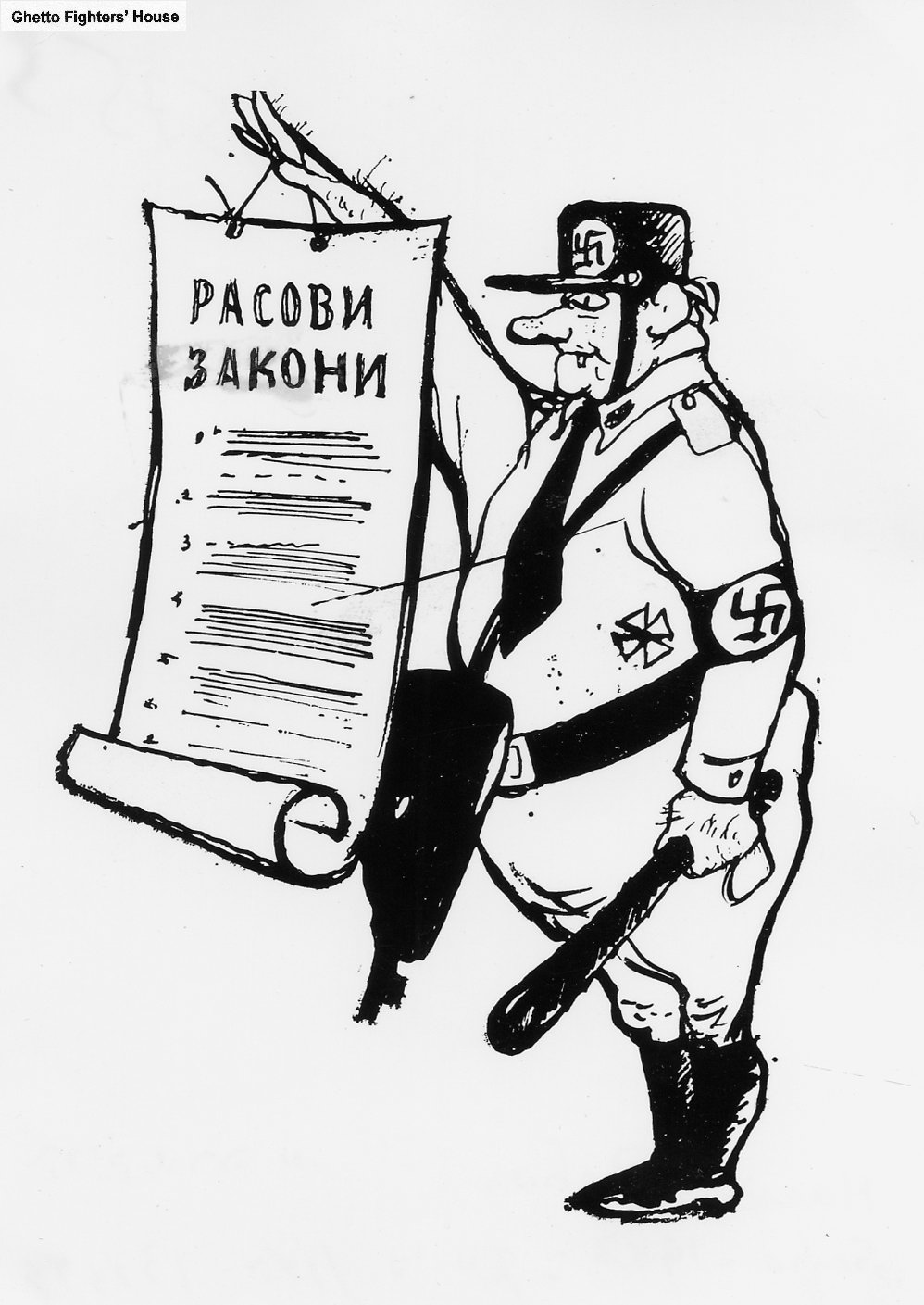
Marko Behar, a talented sketch artist and draftsman (among other mediums), provides us with a unique view into Bulgaria during World War II through his drawings. Behar served as the second commissar of a partisan battalion in the framework of Georgi Dimitrov, who was an international symbol of resistance to Nazism at the time. As such, Behar’s sketches, lithographs, and cartoons reflect partisan and underground life. While he drew moving glimpses of Jewish and partisan life at the time, he also featured caricatures of fascism, such as a cartoon aimed at pro-German authorities in Bulgaria.


Partisans in the Winter, 1948
Monotype
Collection of the Yad Vashem Art Museum, Jerusalem

Behar lived out his days in Bulgaria: he was born in 1914 in Skalitsa, a southeastern town, and passed away in Sofia in 1973. His work has been featured in a number of international exhibitions and has been honored with the Ilia Beshkov prize for drawing. Along with renowned Bulgarian poet, Valeri Petrov, Behar was also one of the founding members and contributors to the popular Bulgarian newspaper Starshel (which translates to “The Hornet”), a weekly publication of humor and satire. His work continues to be exhibited in retrospectives and collections, including a recent (2009) exhibit at the National Gallery of Foreign Art in Sofia.

Clockwise from top left: Race Laws in Bulgaria, 1943, Sofia; A Young Member of the Underground Distributing Leaflets, 1943; Partisans, 1962 (lithograph); Wearing a Jewish Badge, 1943, Sofia.

All materials property of Ghetto Fighters' House, except "Partisans In The Winter", courtesy of the Collection of the Yad Vashem Art Museum, Jerusalem.

Wednesday, May 9, 2012

Defiance, Our Partisan Heroes: Original Poem Inspired By The Jewish Partisans

We recently received this moving poem from Florida educator Bracha Goffer:

Our Partisan Heroes
Holding On To Traditions

What gave them strength to resist?
Preserving pride, self-worth
Resolving not to surrender
To the last breath on earth

How did they safeguard their spirit?
What kept their spark, their drive?
Heads held high amidst evil
How did they last…stay alive?

Lost all loved and dear-ones
Robbed of all they possessed
They marched to their death…to the ovens…
But faith was never repressed…

Clinging to customs, traditions
Their soul they would not betray
Bodies tormented, shattered
Hearts in silence did pray

*

Unspeakable courage and daring
Ignited revolt with a passion
They joined underground forces
To strike at Nazi oppression

These were our Partisan heroes
Defiant, would not succumb
Resisting surrender, submission
Inspired decades to come

The remnants of staggering slaughter
Climbed-out of ashes and sand
An ancient vision pulled Homeward
To build their beloved Homeland

-Bracha Goffer

Bracha is a poet, composer, and educator, as well as an expert in Gematria and Hebrew. She teaches an ongoing Torah class every Tuesday night in Aventura, highlighting “Women spirituality and significance of Israel”.