Search This Blog

Tuesday, January 31, 2012

JPEF Education Manager Jonathan Furst visits Prague, Terezin

JPEF’s Education Manager, Jonathan Furst, traveled to Prague last week to attend the 2012 European League for Middle Level Education Conference. When he was not busy presenting at the conference, Jonathan attended a guided tour of Terezin.

Terezin is a fortress and a town that sits across from the Ohře river in the Czech Republic. Built in the late 1700s by the Hapsburg Monarchy, Terezin was a military town for over two centuries. It was first utilized as a prison in the second half of the 19th century, and housed political prisoners of both World Wars – including Gavrilo Princip, the assassin of Archduke Franz Ferdinand.

During World War II, the Gestapo converted part of Terezin into a Jewish ghetto, interning over 144,000 Jews throughout the course of the war – 33,000 died within its walls due to hunger, disease, and sadistic treatment; only 17,000 prisoners survived. It was also used as a transit camp for European Jews on their way to Auschwitz, and a part of Terezin called the Small Fortress also served as a Gestapo prison for Allied POWs.

Terezin also gained notoriety because the majority of Jews interned there were artists, musicians, professionals, and scholars – their captors encouraged them to lead “creative” lives and even erected and concert venues as a ploy to fool the International Red Cross.

During the guided tour, Jonathan led an impromptu seminar with over twenty European school-teachers participating.

“It was so moving to teach about the spectrum of Jewish resistance in the same place where Jews famously resisted through art, prayer, love and so many other ways – particularly in documenting the reality of the horrors behind the Nazi’s façade of ‘spa’ for elderly Jews.”

“Thanks to Trudi van der Tak for an informative and deeply moving tour, and for inviting me to teach about the wider spectrum of Jewish resistance.”

Friday, January 6, 2012

Featured Jewish Partisan - Jeff Gradow, born on January 5, 1925

"When, at lunchtime, when the German was sitting down and eating and resting, I slid down to a ditch across the highway and I ran in the wood. It was very wooded area. Some of the places you could go for miles, 10-15 miles and not see a human being or civilization. A few minutes, as soon as I ran away, it looks like, they went to counting and one was missing, I could hear shooting from, from, like, I don't know exactly what they did, but they were shooting in the wood, in my direction where I ran away. And that is the first time I felt like a free human being, even I didn't know where the heck I'm going to go, or what I'm going to do."
— Jeff Gradow.

Jeff Gradow was born in 1925 in a small town near Warsaw. When Poland was invaded in 1939, he and his father fled east into Soviet territory. In East Poland, his father got work in a factory in Bialystok and Jeff went to Russian school, soon becoming fluent in the language. When Operation Barbarossa, Germany’s invasion into the Soviet Union, was launched in 1941, Jeff was taken to work as a laborer for the Germans, digging mass graves that he feared would be his own.

Eventually, Jeff took his chances and escaped into the forest. The partisan encampment he found lacked weapons and intelligence contacts needed to target nearby German troops. However, in the spring of 1943 the Soviets made contact with the group, airdropping weapons and explosives to them and sending in professional Russian paratroopers armed with short-wave radios. Reorganized by the paratroopers and boasting a much larger stockpile, the brigade began to fight in earnest. They carried out hit and run sniper attacks, mined roads, and cut phone lines. As the front began to move west, the brigade stood guard over the local bridges, preventing them from being destroyed by retreating Germans and holding them long enough to allow the Soviet tanks to cross.

In the summer of 1944, Bialystok and Baronovich were liberated by the Soviets and Jeff's partisan group was absorbed by the Red Army. He was sent to the front and later discharged after being shot in the hand by a sniper. He convalesced in a hospital outside of Moscow, and by the time he recovered, Berlin was occupied and the war was almost over. He fled Russia and entered West Germany, eventually making his way to the United States. Today, Jeff lives in Los Angeles. He has two grown children and three grandchildren.

Visit www.jewishpartisans.org for more about Jeff Gradow, including six videos of him reflecting on his time as a partisan.

Wednesday, December 21, 2011

Noted philanthropist and long-time JPEF supporter Warren Hellman passes away

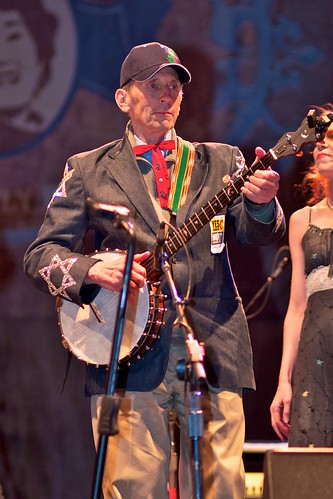
Warren Hellman at Hardly Strictly Bluegrass, 2011San Francisco philanthropist, financier, and supporter of JPEF, Warren Hellman, died Sunday, December 18, 2011 at age 77 of Leukemia. While most know him for his incredible business skills, generosity of spirit, and annual “Hardly Strictly Bluegrass” music festival in San Francisco’s Golden Gate Park, the Board and staff of JPEF will also remember Warren for his generous support of JPEF over the past five years with his wife Chris through the Hellman Family Foundation.

Their philanthropy enabled JPEF to conduct scores of Educator Institutes in the Bay Area and across the globe, impacting thousands of educators and hundreds of thousands of students through the history and life lessons of the Jewish partisans. They also helped build our E-Learning Platform, providing educators with easily accessible training on the use of our cutting-edge educational content. The family was instrumental in the support of JPEF’s international photography exhibit, Pictures of Resistance: The Wartime Photographs of Jewish Partisan Faye Schulman, which has toured the world thanks to the Hellmans, and is coming to Temple Emanu-El in San Francisco this summer. We will dedicate the San Francisco showing to his memory.

Warren Hellman was a great man, whose impact was felt everywhere. He was beloved by many, and we hope his example for using his significant resources and influence for making the world a much better place with such unique passion and enthusiasm will be emulated by others for many generations to come.

Public services will be held Wednesday, December 21, at 1pm at Temple Emanu-El in San Francisco.

Wednesday, November 30, 2011

JPEF will be at NCSS this weekend!


JPEF will be at the NCSS (National Council for the Social Studies) Annual Conference this week in Washington DC. Visit us at booth 428 for free DVDs, posters and curricula, as we promote our new E-Learning Platform. All attendees can join us at our free workshop at 4:20pm this Friday – RESIST: Defying the Myth of Sheep to the Slaughter, taught by JPEF’s Education Manager Jonathan Furst.

We look forward to introducing our programs and materials to the 3,500 educators attending NCSS and getting feedback from those who are using our curricula. Last year we had over 450 educators come to our booth to receive free JPEF materials.

To learn more about the NCSS Annual Conference, go here.